
Reciprocal IVF
One provides the eggs. One carries the pregnancy. Both build the family.
Reciprocal IVF lets same-sex female couples share the biological journey — one partner’s eggs, the other partner’s pregnancy. Two contributions, one child, one family.
What this service is
Reciprocal IVF.
Reciprocal IVF is a fertility treatment designed for same-sex female couples who want both partners to have a biological role in creating their family. One partner provides the eggs — undergoing ovarian stimulation and retrieval — while the other partner carries the pregnancy through embryo transfer and gestation. The result is a child with a genetic connection to one parent and a gestational connection to the other.
The process combines two IVF procedures: an egg retrieval cycle for the genetic parent and an embryo transfer cycle for the gestational parent. Donor sperm from a licensed sperm bank is used for fertilization via ICSI. Contact us for current pricing — the fee covers both partners’ procedures, monitoring, fertilization, and embryo storage.
At Arbor, Dr. Zarek works with both partners throughout the process — coordinating stimulation for the egg provider, preparing the uterine lining for the gestational carrier, and managing the embryo transfer. The timeline typically spans three to six months from initial consultation to transfer, though the pace is always set by you.
Both partners contribute
Two roles. One journey. A child connected to both of you.
What makes reciprocal IVF unique is the shared biology. In standard IVF with donor sperm, one partner does everything — provides the eggs, carries the pregnancy, and delivers the child. The other partner is fully involved emotionally and legally, but not biologically. Reciprocal IVF changes that equation by splitting the biological contribution between both partners.
The decision about who provides eggs and who carries the pregnancy is personal and medical. Factors include age (younger eggs generally produce better outcomes), uterine health, and each partner’s comfort with the physical demands of retrieval versus pregnancy. Dr. Zarek will help you evaluate both options during your consultation — there’s no single right answer, just the answer that’s right for your family.
What’s in the cycle
Two procedures. One coordinated plan.
Reciprocal IVF combines an egg retrieval cycle and an embryo transfer cycle. Contact us for current pricing.

Egg Retrieval
The egg-providing partner undergoes ovarian stimulation and monitoring, followed by egg retrieval under anesthesia. Same protocol as standard IVF — medications are billed separately.

ICSI Fertilization
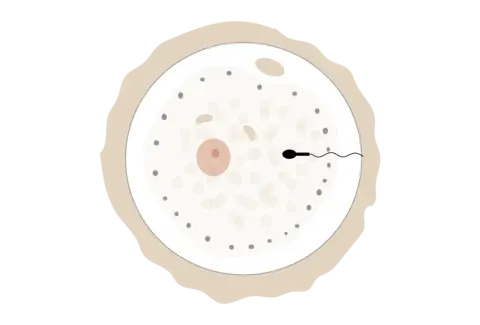
Retrieved eggs are fertilized with donor sperm using ICSI — a single sperm injected directly into each egg. Donor sperm is sourced from your chosen licensed sperm bank.

Embryo Transfer
The carrying partner’s uterine lining is prepared with hormone support, then the selected embryo is transferred via thin catheter guided by ultrasound. Brief office procedure, no anesthesia.

Embryo Storage
Any remaining embryos are vitrified and stored in our on-site facility for one year. Use them for future siblings or additional transfer attempts. Storage renews at $600/year after year one.
Not included: Donor sperm (billed by sperm bank, typically $500–$1,200 per vial), medications for both partners (stimulation + lining preparation), diagnostic testing and infectious disease screening for both partners, embryo biopsy and PGT-A genetic testing, lab fees, and storage after year one ($600/year).
Common questions about reciprocal IVF.
How is reciprocal IVF different from standard IVF?
In standard IVF, the same person provides eggs and carries the pregnancy. In reciprocal IVF, those roles are split between two partners — one undergoes egg retrieval, the other undergoes embryo transfer and carries the pregnancy. This allows both partners in a same-sex female couple to have a direct biological role: one as the genetic parent, the other as the gestational parent. The medical procedures are identical to standard IVF; the difference is in who does what.
How do we decide who provides eggs and who carries?
This is a medical and personal decision. Key medical factors include age (eggs from the younger partner generally produce better embryo quality), ovarian reserve, uterine health, and each partner’s overall fertility profile. Dr. Zarek will evaluate both partners during your initial workup and help you understand the clinical tradeoffs. Some couples have a strong personal preference; others are guided entirely by the medical recommendation. There’s no wrong approach.
Can both partners be genetically connected to the child?
In reciprocal IVF, the child has a genetic connection to the partner who provides the eggs and a gestational connection to the partner who carries the pregnancy. Both partners contribute biologically, but only one is genetically related to the child. This is a meaningful distinction for many families and one of the primary reasons couples choose reciprocal IVF over standard IVF with donor sperm.
How long does the reciprocal IVF process take?
Typically three to six months from your initial consultation to embryo transfer. The timeline includes medical evaluation for both partners, ovarian stimulation and egg retrieval for one partner (about two weeks of active treatment), embryo creation and culture (five to six days), and uterine preparation and transfer for the other partner. If you choose PGT-A genetic testing, add two to three weeks between creation and transfer.
Do we need a sperm donor?
Yes. Reciprocal IVF requires donor sperm from a licensed sperm bank. You select your donor based on physical characteristics, medical history, and personal preferences — the same process as IVF with donor sperm. The sperm bank ships directly to our lab. We work with all major banks and can help you navigate the selection, but the final choice is always yours.
What are the success rates?
Success rates for reciprocal IVF are comparable to standard IVF and depend on the age and fertility health of the egg-providing partner, embryo quality, and the uterine environment of the carrying partner. PGT-A testing can improve per-transfer success rates by identifying chromosomally normal embryos. Dr. Zarek will give you personalized expectations based on both partners’ evaluations.
Often considered alongside
Related services worth a look.

Ready to start the conversation?
Reciprocal IVF is one of the most meaningful ways two partners can share the journey to parenthood. Start with a consultation — we’ll evaluate both partners, discuss the process, and help you decide who does what. The initial 30-minute consult is $100 virtual or $200 in person.