Needle-Free IVF: What to Expect From a Gentler Path


Hi Friends. When I sit across from a new patient and they start to cry before we have even talked about diagnosis, it is almost never about the science. It is about the shots. So let's talk about a gentler path — and what Needle-Free IVF actually looks like day by day.
The IVF injection burden (what "needle-free" replaces)
A standard IVF with ICSI cycle asks a lot of your body, and a lot of your nerves. During ovarian stimulation, most patients give themselves multiple subcutaneous injections every day for roughly 9 to 12 days. The medication has to go in at the same time each evening, which means planning your life — dinners, travel, work trips, bedtime — around a syringe.
For some people, that is uncomfortable but manageable. For others, it is the single reason they delay treatment, pause treatment, or never start at all. I have had patients wait years to come see me because they could not picture themselves holding a needle against their own skin. I have had partners who wanted to help but could not bring themselves to do the injection.
None of that is a character flaw. Needle anxiety is real, and injection fatigue during a long stim cycle is real. The goal of Needle-Free IVF is to take that specific burden off the table without taking anything off the clinical plan.
How Needle-Free IVF actually works
Needle-Free IVF is a protocol, not a product category. Instead of daily self-injections into the belly or thigh, we place a small subcutaneous catheter — a thin, soft tube under the skin — and deliver your stimulation medications through that catheter for the cycle. If you have ever seen a continuous glucose monitor on a friend with diabetes, the device sits on the body in a similar way. One quick placement up front, then medication goes in through the catheter for the days that follow.
The device is designed to stay in place for roughly 9 to 12 days, which covers a typical stimulation window. Our team places it for you the first time so you are not figuring it out alone at your kitchen counter. We walk you through daily medication administration with videos, printed instructions, and a saline flush for the tubing after each dose.
A few honest tradeoffs to know:
- It only handles subcutaneous medications. Anything intramuscular — most notably progesterone in oil, which some patients need after embryo transfer — cannot go through this device.
- Not every medication pen is compatible. The device uses a luer lock (twist-on) syringe. Medications that come in a pre-filled pen or with a non-removable needle may require an extra step.
- It is not "no needles ever." You will still have bloodwork during monitoring, and there is the one small placement step. What you are trading is daily injections for one device and a handful of lab draws.
When I explain it this way, most patients exhale. It is not a miracle — it is a real clinical alternative with real limits. For the right person, those limits are worth it.
Who is a good candidate
Needle-Free IVF is not for everybody, and I want to be straightforward about that. It tends to be a strong fit for:
- People with significant needle anxiety or a history of fainting, panic, or avoidance around injections.
- Patients who have been through one or more IVF cycles and are dealing with bruising, skin irritation, or emotional fatigue from frequent shots.
- Egg freezing patients who want a lower-friction stim experience and whose protocol is all subcutaneous.
- Solo patients or couples who do not have a reliable second set of hands at home to help with injections.
- Anyone who has been putting off IVF specifically because of the needles.
It may not be the right fit if your protocol requires medications that cannot be delivered subcutaneously, or if you have a skin condition at the planned placement site.
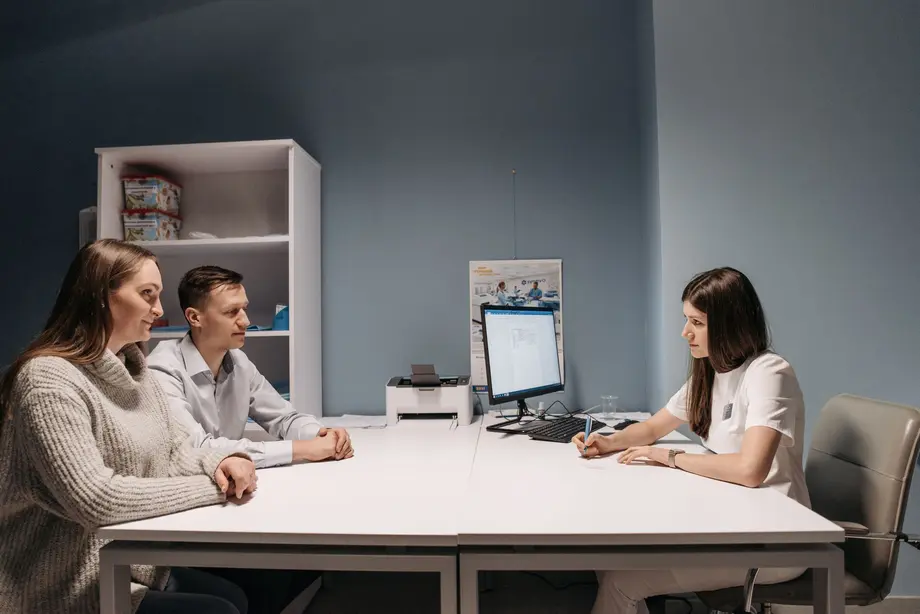
The honest version: the best way to know is a conversation. During your consultation, we look at your diagnosis, the protocol we would recommend, and your own comfort level — and tell you whether Needle-Free IVF makes sense for your cycle or whether a standard protocol will serve you better.
A typical cycle, day by day
Every cycle is personalized, so treat this as a general shape rather than a calendar. Your actual dates and dosing will come from your care plan.
- Before day 1 — baseline and device placement. You come in for a baseline ultrasound, with baseline bloodwork drawn at a Quest or Labcorp near you. If everything looks good to start, our team places the catheter for you in clinic and shows you exactly how to attach the syringe, flush the line, and protect the dressing.
- Days 1 through 4 — stimulation begins at home. You administer your medication through the catheter at the same time each evening. No self-injection. You flush the line with saline after each dose. Most patients describe this part as "strangely uneventful," which is exactly what we want.
- Days 5 through 8 — monitoring visits. You come back for short monitoring ultrasounds (with bloodwork drawn at a local lab on our order) so we can see how your follicles are responding and adjust your dose. The device stays in place.
- Days 9 through 11 — trigger window. When your follicles are ready, we plan the trigger shot. Depending on which trigger medication your protocol uses, this step may go through the device or may require a separate injection. We tell you ahead of time so there are no surprises.
- Retrieval day. Egg retrieval itself is the same procedure whether you did Needle-Free IVF or a standard protocol — a short outpatient procedure under anesthesia. The catheter is removed around this point.
- After retrieval. From here, the path depends on your plan: embryo freezing followed by a frozen embryo transfer in a later cycle, or egg freezing. If your post-retrieval plan calls for intramuscular progesterone, that part of the cycle uses traditional injections.
The day-to-day rhythm of a stim cycle — the monitoring, the dose adjustments, the trigger, the retrieval — does not change. What changes is how the medicine gets into you.
What patients commonly ask
"Does it hurt when you place the device?" The placement is quick, and most patients tell us it is noticeably less uncomfortable than a typical subcutaneous injection. There is a brief pinch, and then the catheter sits under the skin without you really noticing it. You trade that one moment for the dozens of shots you would have done at home.
"Can I still live my life with the device on?" Yes. You can work, sleep, cook, chase kids, and go about your normal routine. We ask you to be careful with anything that would soak or stress the dressing — swimming, hot tubs, saunas, steam rooms, hot yoga — because sweat and water can weaken the adhesive. Regular showers are fine.
"Will I still need any injections at all?" Possibly, and I want to be honest about that. Some trigger medications and most intramuscular medications (like progesterone in oil, if your protocol calls for it) cannot go through the device. We walk through your exact medication list during consultation so you know up front which parts of your cycle are needle-free and which are not.
"Is this as effective as regular IVF?" The clinical intent is to deliver the same stimulation protocol through a gentler route, and early evidence suggests comparable outcomes in egg yield, fertilization, and pregnancy when patients are properly monitored. We are not promising a better cycle — we are offering a more comfortable way through the same cycle.
"Is there an extra cost?" Needle-Free IVF is an optional protocol add-on, and pricing is handled separately from the standard IVF package. We will walk you through the exact cost during your consultation.
Key takeaways
- Needle-Free IVF replaces most daily stim injections with a single small subcutaneous catheter that stays in place for the ~9 to 12 days of your stimulation window.
- It is designed for people whose biggest barrier to IVF is the shots themselves — needle anxiety, injection fatigue, bruising, or no one at home to help.
- It does not eliminate all needles. Bloodwork continues, and intramuscular medications (such as progesterone in oil) still require traditional injection.
- It is a protocol choice, not a different treatment. The clinical plan — monitoring, retrieval, fertilization, transfer — is the same. Only the delivery method changes.
- Candidacy is a conversation. The right answer depends on your diagnosis, your protocol, and what you need to get through a cycle with your nervous system intact.
Talk to Arbor Fertility
If needles are the reason you have been hesitating, I want you to know that hesitation is information — and it is something we can work with. Come have a conversation with us. We will look at your situation honestly, tell you whether Needle-Free IVF is a fit for your cycle, and walk you through every step before you commit to anything. Start your fertility journey with Arbor Fertility and let's talk about a gentler path toward parenthood.